

High in the green mountains of South-East Asia, a slender vine climbs over itself through the cool, damp air, its leaves divided into five like an open hand. The people who have lived alongside it for centuries gather it, dry it, and steep it into a soft, sweet daily tea. They gave it a name that has travelled the world with it: xiancao, the herb of immortality. This is jiaogulan.
It is one of the gentlest and best loved of the tonic herbs, and one of the most over-promised. This guide gathers the honest picture in one place: what jiaogulan is, why it carries such a grand old name, what it tastes like, what the research has and has not found, how to brew a good cup, who should take care with it, and where ours is grown.
Jiaogulan (Gynostemma pentaphyllum) is a climbing vine native to southern China and South-East Asia1. It belongs to the gourd family, the same broad family as cucumber and melon, and grows wild through the warm, humid hills of the region. Its leaves carry a group of natural compounds called gypenosides, which are close relatives of the ginsenosides found in ginseng. That kinship has earned jiaogulan the nickname southern ginseng, though it is a quite different plant, far gentler to drink and naturally free of caffeine.
Its old Chinese name, xiancao, translates as the herb of immortality, and the name comes from a story rather than a promise. In the mountain villages of southern China where the vine grew wild and was drunk daily as a tea, people were said to live long and vigorous lives, and the herb became woven into that reputation. We tell it as the lovely piece of folklore it is, a name carried down through tradition, not a claim about what a cup of tea can do.
It goes by other affectionate names too. For the way its chemistry echoes ginseng's, it is called southern ginseng; for how gently it drinks day to day, women's ginseng. It is a different plant from true ginseng entirely, but the family resemblance in its compounds is real.
No. Jiaogulan is not a true tea at all, not a leaf of the Camellia sinensis plant that gives us green and black tea, but a herb in its own right, and it is naturally free of caffeine. That single fact is much of its gentle appeal. You can drink it last thing in the evening as easily as first thing in the morning, with none of the lift-and-crash that coffee can bring. It is a cup that suits any hour, which is part of why so many people keep it close through long or irregular days.
This is where jiaogulan tends to surprise people. You might expect a green leaf to be grassy or sharp; instead a well-made cup is delicate and softly sweet, clean and rounded, with a sweetness that lingers gently after each sip. Our customers reach again and again for the same words: delicate, slightly sweet, soft, and not bitter. Any bitterness really only appears if the leaf is over-steeped or stirred too hard, so a gentle hand keeps the cup sweet. It is, as one person put it, a tea that feels clean and special, and one that lasts, the leaves giving freely over several brews.
For centuries jiaogulan has been drunk as an everyday tonic tea across southern China and South-East Asia, taken not for any single complaint but for steadiness: for energy that does not spike, for stamina through a long day, and as a gentle companion in times of strain. It is traditionally counted among the adaptogens, the family of plants that herbal traditions have long reached for to help the body meet stress and find its balance.
There is an old way of describing it that captures the idea well. A stimulant works like a switch, pushing you in one direction whatever your starting point. An adaptogen is spoken of more like a thermostat, helping the body settle towards its own balance: easing you down when you are wired and tired, lifting you gently when you are flagging. That is the traditional view of how jiaogulan is used, and it is why it has been such an easy herb to live with, day after day, for so very long.
Jiaogulan has been valued in tradition far longer than it has been studied in a laboratory, and the modern research is still young. A handful of small human trials have looked at concentrated jiaogulan extracts, and it is worth being clear about what they did and did not show.
In a randomised, double-blind, placebo-controlled trial, a Gynostemma pentaphyllum leaf extract was associated with lower self-reported anxiety in healthy adults living with chronic stress, although the researchers were careful to add that more study is needed2. In two further randomised trials, jiaogulan extracts were associated with greater resistance to exercise-induced fatigue3, and with improved exercise performance in healthy men4. Other randomised trials have studied concentrated extracts in the context of body composition, with some reporting reductions in body fat in overweight adults56.
Two honest notes belong here. First, these trials used concentrated extracts of the same herb at controlled doses, so they show what jiaogulan has been studied for, rather than a promise for any single cup. Second, several of these studies were small, early, and funded by the companies that make the extracts. We share them because they are genuine and interesting, not because they settle anything. Jiaogulan is a tea to enjoy in the spirit it has always been enjoyed: as a daily cup, traditionally valued, rather than a remedy.
Jiaogulan is forgiving and generous, and a good cup asks very little of you.
Because it is caffeine-free, there is no wrong time of day for a cup.
Jiaogulan is widely enjoyed as a daily tea, but a few people should take care.
As with any herb, if you are pregnant, breastfeeding, taking medication or managing a health condition, please speak with a qualified healthcare professional before making jiaogulan a daily habit.
It is traditionally counted among the adaptogens, the plants herbal traditions have long used to help the body cope with stress. That is a traditional way of describing how it is used, rather than a medical claim.
No. It is a different plant, from the gourd family rather than the ginseng family. It earns its southern ginseng nickname because its active compounds, the gypenosides, are close relatives of the ginsenosides in ginseng, and because it is far gentler to drink every day.
It should not. Jiaogulan is naturally caffeine-free, which is why many people happily drink it in the evening.
It has been drunk as a daily tea for generations, and a cup or two a day is the usual way to enjoy it. Most of the formal safety research covers shorter periods of a few months, so if you plan to drink it daily over a long stretch, and especially if you are pregnant, breastfeeding, on medication or managing a health condition, it is worth a word with a professional first.
Keep it in a sealed container in a cool, dry place away from direct light, and the leaf will hold its delicate sweetness and colour for a good while.
Our jiaogulan is grown high in the mountains of Northern Thailand, by a collective of tribal farmers who tend it with great care and only organic practices. The leaf is single-harvest, de-stemmed and hand-rolled, then gently pan-dried to protect its natural compounds.
One honest note about the word organic. The co-operative grows the plant organically, but cannot meet the high fees that international organic certification charges on every individual farm, so we are not able to label it certified organic. We would rather tell you that plainly than imply something we cannot stand behind. You can read more about how we work in our sourcing policy.
Jiaogulan does not need the legend that gave it its name. It is enough as it is: a gentle mountain vine, drunk as a daily cup for longer than anyone can quite remember, soft and sweet and easy to live with. Whether you reach for it to begin the morning or to set the day down in the evening, it asks little and gives generously, brew after brew.
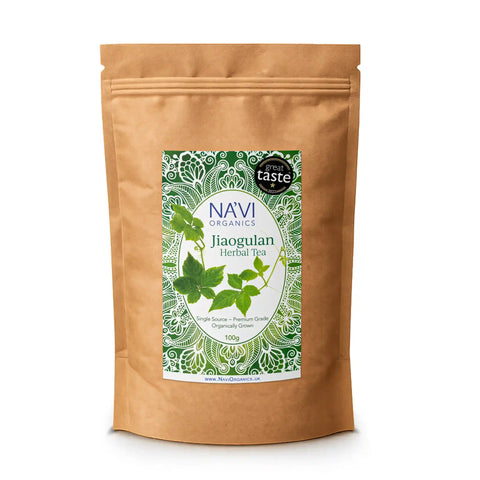
Explore our Jiaogulan Loose Leaf Tea, whole-leaf and hand-rolled, mountain-grown in Northern Thailand.
Written by Ellie May, a researcher and writer who studies traditional plant, fungi and mineral knowledge, and a guest writer for Na'vi Organics. She writes longer guides on medicinal mushrooms, tonic herbs and Ayurvedic traditions, drawing on both scientific research and folklore. Ellie is a researcher and writer, not a medical practitioner, and nothing here is medical advice. Published 18 March 2026.