

There is a moment, just after the butter clears, when the kitchen fills with the warm, nutty scent of something very old being made new again. The milk solids settle and toast gently at the bottom of the pan. The liquid above turns a deep, translucent gold. If you have never made ghee, this moment will surprise you. It smells like trust. Like someone has been tending something for a very long time.
Ghee is clarified butter, simmered slowly until the water evaporates and the milk solids separate and lightly toast. What remains is pure butterfat: golden, shelf-stable, and deeply woven into the culinary and healing traditions of India, where it has been revered for thousands of years as both a nourishing food and a carrier for herbal medicines. In classical Ayurvedic texts, it is described simply as "the first and most essential of all fats."
We carry two ghees at Na'vi, and they could not be more different in origin, yet they share the same principle: what the animal eats, how the land is tended, and how the butter is handled matters as much as the finished jar. This is a guide to understanding those differences and knowing what to look for.
At its simplest, ghee is butter with the water and milk solids removed. But calling it "just clarified butter" misses the point, the way calling bread "just flour and water" misses the point.
The traditional method involves simmering unsalted butter over low heat. The water evaporates. The casein and lactose-containing solids separate and drift to the bottom of the pan, where they are allowed to toast lightly before being strained away. This toasting is what sets ghee apart from European-style clarified butter. It gives ghee its deeper golden colour, its nutty warmth on the palate, and that particular richness that transforms everything it touches.
Because the milk solids are removed, ghee contains only trace amounts of lactose and casein. Many people who are sensitive to dairy find they tolerate ghee well, though individual responses vary.
The process is ancient and remarkably consistent across cultures. In India, ghee is central to daily cooking, religious ceremony and Ayurvedic practice. In the Middle East, a similar product called samna has been made for centuries. What is consistent across all of these traditions is the understanding that good fat, prepared with care, is foundational to good food and good health.
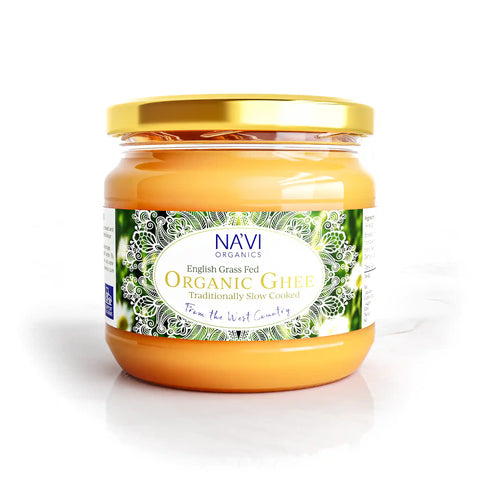
Our Organic English Ghee is made from the milk of pasture-fed cows grazing on open English countryside. It is produced in small batches, traditionally, by people who care about the animal, the land and the finished product.
You can see it in the colour. Pasture fed ghee shifts with the seasons. In spring and summer, when the grass is rich with chlorophyll and the cows are eating their fill of fresh pasture, the ghee deepens to a vivid amber gold. In winter, it pales slightly. This is not a flaw. It is a record of the land, written in fat.
The difference between pasture fed and grain-fed ghee is not subtle. Butter from pasture-fed cows tends to carry higher levels of fat-soluble vitamins (particularly A, D, E and K2), conjugated linoleic acid (CLA) and omega-3 fatty acids. But even before you read a nutritional panel, your palate will tell you. Pasture fed ghee has a richness and complexity that grain-fed ghee simply does not carry. It is the difference between a tomato grown in soil and one grown in a polytunnel. Both are tomatoes. But you know the difference when you taste them.
We chose English pasture-fed ghee because we wanted to offer something rooted in this landscape, from animals that live on grass, under open skies, tended with respect. It arrives in a glass jar, as all good ghee should.
Our second ghee comes from a very different world, but the same principle.
On a small farm in India, Desi Gir cows graze freely in the tradition they have been kept for thousands of years. These are indigenous cattle, native to Gujarat, and they produce milk that is naturally A2, meaning it contains only the A2 form of beta-casein protein. Some people report finding A2 dairy gentler on digestion than conventional dairy, though the research is still emerging.
What makes this ghee truly distinctive is not only the breed, but the method and the farming practice.
The farm follows HOMA organic principles. This is a Vedic agricultural practice centred on Agnihotra, a fire ceremony performed at sunrise and sunset. It is ancient, far older than modern organic certification, rooted in a worldview that sees farming as a sacred act. The ceremony is believed to purify the atmosphere and nourish the soil. Whether you approach this as science, as tradition, or simply as a different way of relating to the land, the result is food grown with an intention you can feel.
The ghee itself is made by the Bilona method, the oldest known process for making ghee. Whole milk is set to curd. The curd is hand-churned to extract butter, and that butter is slowly simmered into ghee. This is not how modern ghee factories work. They separate cream mechanically, churn it industrially, and simmer at scale. The Bilona process is slower, more labour-intensive, and it produces a ghee with a different texture, aroma and depth. In the Ayurvedic tradition, Bilona ghee is considered to carry a different quality of prana, or life energy.
It arrives in a glass jar, carrying something you will not find on a factory line. Call it intention. Call it reverence. We call it HOMA organic.
In Ayurveda, ghee is not simply a cooking fat. It is a carrier, a nourisher, a medicine in its own right.
Traditionally, ghee was used as a vehicle for herbal medicines because of its believed ability to carry the properties of herbs deep into the body's tissues. Tonic herbs like ashwagandha and shatavari were often prepared in ghee to enhance their absorption. It was also used topically, for the eyes, for the skin, and in ceremonial practice. Ghee lamps (diyas) have been lit in temples and homes across India for thousands of years, a small flame held in the most nourishing fat the tradition knows.
In Ayurvedic dietary guidance, ghee is considered sattvic: pure, harmonising, and supportive of clarity. It is recommended in moderate amounts for all body types, though the quantity varies with individual constitution and season.
We share this context with respect and without making health claims. Ayurveda is a vast and living tradition. Our role is to offer products that honour it, not to reduce it to marketing points.
If you have never cooked with ghee, you are in for a gentle revelation.
Ghee has a high smoke point (around 250C), which makes it one of the most stable cooking fats available. It does not break down or oxidise at the temperatures that damage olive oil or butter. This makes it ideal for:
A little goes a long way. Good ghee is not something you pour. It is something you fold in, gently, the way you would add warmth to anything that matters.
The UK ghee market has grown rapidly, and not all of it is equal. Here is what separates ghee made with care from ghee made at scale:
| Ghee Made with Care | Commodity Ghee | |
|---|---|---|
| Cows | Pasture fed or heritage breed (A2 Gir) | Grain-fed, breed unspecified |
| Method | Traditional Bilona or small-batch | Industrial cream separation |
| Colour | Deep gold to amber, shifts with season | Uniform pale yellow |
| Aroma | Warm, nutty, complex when you open the jar | Neutral or faintly greasy |
| Flavour | Rich, rounded, caramelised | Flat, one-dimensional |
| Packaging | Glass jar (preserves potency, no leaching) | Plastic tub |
| Organic | Certified organic or HOMA grown | Conventional |
| Traceability | Farm or region identified | "Product of more than one country" |
A simple test: open the jar and breathe in. Good ghee should smell warm and nutty and alive. If it smells neutral, or faintly of nothing, it was made in volume from commodity butter, with efficiency rather than care as the guiding principle.
Both of our ghees arrive in glass jars. This is not an aesthetic choice. Ghee is pure fat, and fat absorbs what it touches. In a plastic container, that means trace compounds from the plastic migrating into the ghee over time. In glass, the ghee remains as it was when it was poured: pure, stable, uncontaminated.
Glass is heavier to ship and more expensive to source. We use it anyway, because the integrity of what is inside the jar matters more than the logistics of getting it there.
We offer two ghees because we believe in two traditions. One rooted in the English countryside, in green pasture and seasonal rhythm. The other rooted in Vedic India, in ancient ceremony and the gentle hands of people who see farming as prayer. Both arrive in glass. Both are made with the kind of attention that most food has forgotten.
Our Organic English Ghee | Our A2 Vedic Bilona Ghee | View all ghee
Related reading: Ashwagandha Benefits for Women | What is Shilajit?